When to Go to Santa Teresa, Costa Rica
When to Go to Santa Teresa, Costa Rica
When to Go to Santa Teresa, Costa Rica: A Month-by-Month Guide for Every Type of Traveler
The honest breakdown of dry season, rainy season, crowds, waves, and what the weather actually feels like on the ground — from someone who knows this place well.
Introduction:
There's No Perfect Month...
But There Is a Perfect Time for You
Santa Teresa is one of those places that people tend to romanticize before they arrive and fall genuinely in love with once they do. Perched on Costa Rica's Nicoya Peninsula along the Pacific coast, it has the kind of raw, salt-in-the-air beauty that makes you want to stay longer than you planned. But one of the most common questions travelers ask before booking is also one of the most misunderstood: when is the best time to visit?
The honest answer is that it depends entirely on what you're looking for. Santa Teresa has two distinct seasons — dry and rainy — and each one offers a genuinely different experience of the same place. Neither is objectively better. What matters is matching the season to your travel style, your priorities, and your tolerance for heat, mud, or crowds.
This guide breaks it all down clearly, so you can stop second-guessing your dates and start planning the trip you actually want.
tWeather in Santa Teresa, Costa Rica:
What You Need to Know First
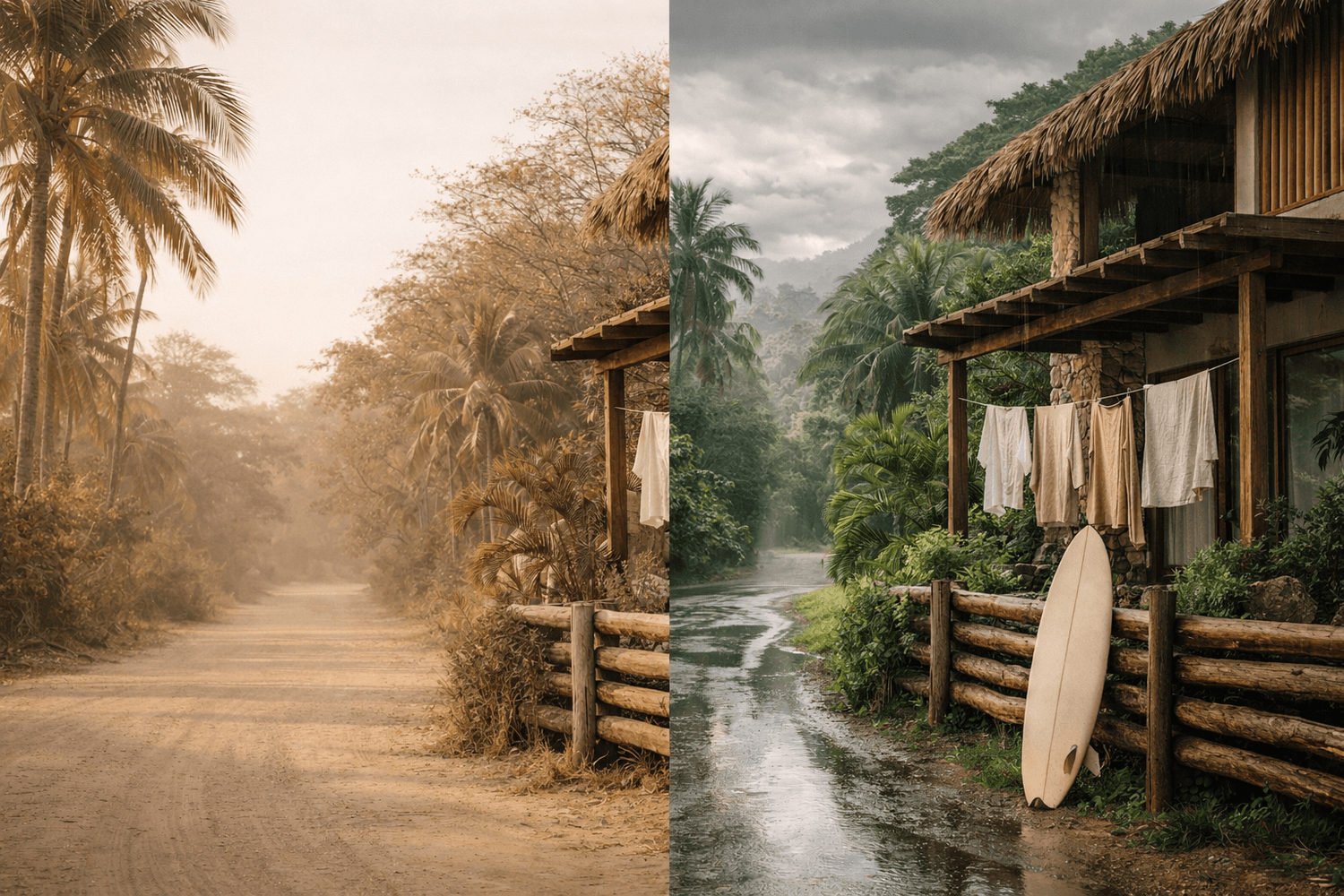
Santa Teresa sits in the tropics, which means the climate operates on a fundamentally different logic than most travelers are used to. Forget four seasons. Here, the year is divided into two: the dry season (locally called verano, meaning summer) and the rainy season (invierno, or winter) — and both names can be misleading if you've never experienced them.
Temperatures stay warm year-round, typically hovering between 25°C and 34°C (80–93°F) during the day regardless of season. The real variable isn't heat — it's rainfall, humidity, road conditions, crowd levels, and surf quality. Understanding those variables is what will help you pick the right time for your trip.
Dry Season in Santa Teresa: December to April
The dry season runs from December through April, and this is when Santa Teresa is at its most accessible, its most social, and — let's be direct — its most crowded and expensive.
The weather during these months is reliably beautiful. Days are long and sunny, rainfall is minimal, the roads are passable even without a 4x4 (though one always helps), and the ocean tends to be calmer and more inviting for swimming. This is peak tourist season, which brings both the energy of a lively destination and the downsides of higher prices and fuller beaches.
Mid December and January: Peak Season at Full Swing
Mid December and January are the busiest months of the year in Santa Teresa. The combination of Christmas and New Year's, North American and European winter holidays, and ideal weather conditions creates a perfect storm of demand. Accommodation books out weeks or months in advance, prices are at their annual high, and Playa Carmen in particular can feel genuinely busy by Santa Teresa standards.
That said, there's an undeniable buzz to Santa Teresa during this period. The restaurants are full, the surf schools are packed, and the social energy at the beach and in town is at its peak. If you enjoy being around other travelers and want the full, vibrant version of Santa Teresa, this is your season — just book early and budget accordingly.
Local tip : During this time of the year, the population of the Cobano area — which includes Santa Teresa — grows dramatically. What is usually a quiet region of around 20,000 residents can swell to nearly 200,000 people during the peak holiday weeks.
So be prepared for a much livelier atmosphere. Traffic along the main road can get busy, and you certainly won’t be alone when watching the sunset on the beach. But that’s also part of the charm of this short period: the energy, the crowds, and the feeling that something is happening all the time, day and night.
February and March: The Sweet Spot of Dry Season
Many experienced visitors — and most locals — consider February and March to be the ideal months to visit Santa Teresa. The holiday crowds have thinned out, prices ease slightly, the weather remains excellent, and the surf is often at its most consistent. You get nearly all the benefits of peak season with fewer of the drawbacks.
The light in February and March is also extraordinary — long golden afternoons, dramatic sunsets, and enough warmth to be in the water from morning until evening. If your dates are flexible, this is the window worth prioritizing.
Local tip : One thing to keep in mind, though: if you’re sensitive to heat, these months — along with early April — are usually the hottest of the year. Daytime temperatures can easily reach around 100–102°F (38–39°C) under the tropical sun.
Make sure to pack plenty of sunscreen and your favorite hat, because the midday heat can be intense, especially if you plan to spend a lot of time at the beach or exploring the town.
April: The Transition Month
April sits in an interesting in-between space. The dry season is technically still in effect, but the first rains of the year can begin to appear toward the end of the month, usually in the form of brief afternoon showers rather than sustained rainfall. Crowds and prices start to drop, making April a reasonable shoulder season option — especially for travelers who want good weather but don't want to compete with peak-season crowds for tables at dinner.
Rainy Season in Santa Teresa:
May to November
Here's where the misunderstanding usually begins. Many travelers see "rainy season" on a travel guide and immediately remove those months from consideration. That's a mistake — and it's one that causes a lot of people to miss out on a genuinely special version of Santa Teresa.
The rainy season does not mean it rains all day, every day. It means that rainfall is more frequent, usually arriving in the form of heavy afternoon or evening downpours, often followed by clear skies. Mornings in the rainy season are frequently sunny and calm. The jungle turns an almost surreal shade of green. The waterfalls are full. The rivers run. The landscape is alive in a way that the dry season simply cannot match.
May and June: The Green Season Begins
May marks the start of the rainy season, and the transition can feel almost overnight. The landscape visibly shifts within days of the first sustained rains — the dusty roads of April become lush corridors practically overnight. Tourist numbers drop sharply, accommodation prices fall, and the town takes on a quieter, more local character.
For travelers who've been before and want to experience a different side of Santa Teresa, May and June offer exactly that. The surf also starts to improve during this period, as the Pacific swells begin to build.
July and August: Surf Season Peaks — and So Do Waves
July and August are prime surf season in Santa Teresa. The swells that roll in from the South Pacific during these months produce some of the most powerful and consistent waves of the year. For experienced surfers, this window is genuinely unmissable. The trade-off is that conditions can be rougher for beginners, and the rain is more frequent — but plenty of travelers find the rhythm of morning surf sessions followed by afternoon rain perfectly workable.
Local tip : June is generally considered the rainiest month of the year in Santa Teresa. If rain is a dealbreaker for you, keep in mind that it’s not uncommon to experience one or even two full days of continuous rain during this period.
The weather here can be quite unpredictable, so it’s best to plan your trip with the expectation that rain will happen at some point. On a good day, showers may only arrive in the evening, but on others, it can rain for most of the day.
September and October: The Quietest Months
September and October are the quietest months in Santa Teresa, and also the wettest. Rainfall is at its most sustained during this period, and some travelers do find the weather limiting. A number of businesses reduce their hours or close entirely for renovation or owner vacations. Roads in the northern Santa Teresa area and around Playa Hermosa can become genuinely difficult to navigate without a 4x4.
However, accommodation prices are at their annual lowest, the beaches are nearly empty, and there's a slowness to the town during these months that some travelers find deeply restorative. If you're a digital nomad, a writer, or anyone who came to Costa Rica to genuinely switch off, September and October offer a version of Santa Teresa that most visitors never see.
November: The Shoulder Season Return
November is a gentle transition back toward the dry season. Rain becomes less frequent, the roads improve, and early visitors start to trickle back. Prices are still relatively low, and you can often find accommodation with genuine ease. November is an underrated month to visit Santa Teresa — and one worth considering if your schedule allows it.
Local tip : If you’re planning to visit Santa Teresa toward the end of the rainy season, there is one main advantage and one important drawback to keep in mind. The biggest highlight is the landscape. Nature is at its peak, and the whole area feels like a lush tropical jungle, with deep green vegetation and a heavy, humid atmosphere that makes everything look incredibly vibrant.
The downside, however, is the road conditions. After months of rain, some roads can become quite challenging. Large puddles and muddy sections are common, and certain areas may be difficult — or even impossible — to access without a proper 4x4 vehicle.
Common Mistakes Travelers Make When Choosing Their Dates
Dismissing the rainy season entirely. This is the single biggest planning mistake. The rainy season offers lower prices, better surf, lush landscapes, and a far more authentic experience of Santa Teresa. Travelers who avoid it based on the name alone are the ones who later wish they'd known.
Booking peak season accommodation last minute. December and January in Santa Teresa are not a last-minute destination. The best properties book out months in advance, and arriving without a reservation in peak season means either compromising on location, paying a premium for whatever's left, or both.
Not accounting for travel days in their planning. Getting to Santa Teresa takes time — whether you're flying into Liberia or San José and then driving, or taking a domestic flight to Tambor and shuttling in. Factor in at least a half day of travel buffer, especially if you're arriving during rainy season when road conditions can add to journey times.
Underestimating the October/November shoulder season. Many travelers who visit in « autumn » are surprised by how manageable it is — and how peaceful. It has a reputation as the worst months that isn't entirely deserved.
Conclusion:
Choose Your Season,
Then Commit to It
There's no universally perfect time to visit Santa Teresa. What there is, for every type of traveler, is a best time — and knowing the difference between them is what separates a good trip from a great one.
If you want sunshine, social energy, and calm water for swimming, come between December and March. If you want powerful surf, green jungle, lower prices, and a more local version of Santa Teresa, the rainy season has more to offer than most people expect. And if flexibility is your superpower, February, March, and November are the sweet spots where good weather, manageable crowds, and fair prices all overlap.
Whatever you choose, Santa Teresa will meet you where you are. The place has a way of doing that.
Local tip : A small local tip: if you want to enjoy everything Santa Teresa has to offer — from hotels and restaurants to activities and nightlife — the rainy season can be a little more limiting. Many hotels and restaurants take advantage of this quieter period to close temporarily for renovations or maintenance.
That being said, local life doesn’t stop completely. You’ll still find plenty of restaurants open, as well as gyms, surf shops, and other essentials. It can actually be a great opportunity to experience the town from a different perspective and meet the people who live here year-round — and there aren’t that many of them.
Have a question about timing your visit to Santa Teresa? Leave a comment below or get in touch — I'm always happy to help you plan a trip that actually fits how you travel. If you’re planning a trip and want to make things easier, we also created a detailed Santa Teresa travel guide with practical tips, recommended places, and everything you need to organize your stay.